
Budget 2025: Key Points at a Glance (United Kingdom)
united kingdom
LATEST ARTICLE
11/26/20253 min read

Introduction
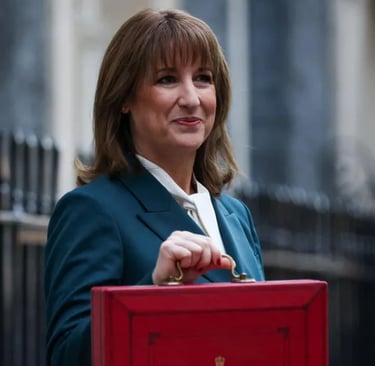
The United Kingdom’s Budget 2025 has introduced major financial and taxation reforms that are expected to impact millions of citizens, businesses, and public-sector services. Delivered by the Chancellor, this year’s budget focuses heavily on raising revenue, supporting low-income families, and reforming property and pension systems. With significant tax changes, social-welfare reforms, and economic adjustments, Budget 2025 is one of the most consequential financial plans of the decade.
This article breaks down all key points at a glance, allowing readers to understand the most important changes without confusion.
1. Major Tax Changes
One of the most talked-about aspects of Budget 2025 is taxation. New policies are aimed at increasing government revenue while targeting higher-income households.
A. Income Tax Threshold Freeze
Income tax and National Insurance thresholds will remain frozen until 2031.
As wages rise with inflation, more people will gradually fall into higher tax brackets.
B. Mansion Tax Introduced
A new “mansion tax” has been introduced on properties valued over £2 million.
This measure is aimed at wealthier households and expected to generate billions in revenue.
C. Dividend Tax Increase
Tax on dividend income has been increased.
This particularly affects investors, landlords, and business owners who rely on dividends.
D. Crackdown on Tax Avoidance
Stronger enforcement measures will target loopholes.
Digital reporting and audits will be enforced more strictly on large companies and high earners.
2. Support for Families & Low-Income Households
A major highlight of the budget is the government’s emphasis on reducing child poverty and increasing social welfare.
A. Two-Child Benefit Cap Removed
The two-child benefit restriction has been abolished.
Nearly 450,000 children are expected to benefit from this change.
B. Increase in Living Wage
The UK Living Wage has been raised to help millions dealing with inflationary pressure.
The new wage increase is expected to benefit low-income workers across retail, hospitality, and service sectors.
C. Benefits Adjusted for Inflation
Universal Credit and other benefits will rise in line with inflation.
This ensures vulnerable groups aren’t left behind as the cost of living grows.
3. Property & Housing Reforms
The housing sector sees notable restructuring with aims to make the market fairer.
A. Higher Taxes on High-Value Properties
As mentioned, the mansion tax targets luxury properties.
The goal is to limit inequality in the property sector.
B. Rental Reforms
Measures introduced to protect tenants from unfair rent increases.
More regulations for landlords on maintenance and safety standards.
C. Incentives for Affordable Housing
Additional funds dedicated to building affordable homes.
Government partnerships with construction and housing associations expanded.
4. Public Services: Health, Energy & Transport
Budget 2025 places heavy focus on improving essential public services.
A. NHS and Health Services
Additional funding directed toward the NHS to reduce hospital wait times.
Investment allocated for digital healthcare transformation, including AI-based diagnosis systems.
B. Energy Costs Relief
Household energy bill levies have been removed to make bills cheaper.
This comes as a relief amid rising global energy prices.
C. Transport: Rail Fare Freeze
Regulated rail fares are frozen for another year.
Public transport users — especially daily commuters — benefit directly.
D. Prescription Charge Freeze
Prescription costs will remain unchanged for the year.
This supports elderly and low-income patients.
5. Pension System Changes
One of the biggest shocks in Budget 2025 was the reform in pension perks.
A. Salary-Sacrifice Pension Perk Reduced
The popular tax benefit on salary-sacrifice pension contributions is being limited.
Higher earners will be most impacted, as this was previously used to reduce tax liability.
B. State Pension Increase
In positive news, the State Pension rises in line with wage growth and inflation.
Pensioners will see increased monthly payments.
6. Business & Investment Reforms
Budget 2025 also targets economic growth by resetting the business environment.
A. Corporate Tax Reforms
Certain loopholes for multinational companies have been closed.
Stricter tax reporting for large corporations comes into effect.
B. Incentives for Small Businesses
Grants and tax reliefs expanded for SMEs.
Digital-first business adoption encouraged through discounted tech grants.
C. Innovation & Green Investment
Green technologies, electric vehicles, and renewable energy startups receive fresh funding.
The UK aims to remain competitive in global green industry leadership.
7. Education & Skills Development
Increased investment in vocational training and apprenticeships.
Focus on equipping the workforce with digital, AI, and engineering skills.
Additional funding for schools in deprived areas.
8. Economy Outlook & Revenue Goal
The total budget aims to raise £26 billion in additional revenue.
Economic growth is projected to be modest but stable.
Government hopes budget reforms will reduce the national deficit.
Conclusion
Budget 2025 brings a mix of tax rises, social benefits, and economic restructuring.
While high-income households face increased taxation, low-income families and public-service users benefit from improved welfare packages, energy-bill relief, and stronger government support.
For many citizens, this budget represents a shift toward fairness, redistribution, and long-term economic stability — but it also places a heavier financial burden on wealthier communities and investors.
Keywords
UK Budget 2025
Budget 2025 key points
United Kingdom budget summary
Budget 2025 tax changes
Rachel Reeves budget 2025
UK mansion tax 2025
UK income tax freeze
UK welfare reforms 2025
Budget 2025 explained
UK pension reforms 2025
Contact
Stay updated with us
Phone
+92-300-1234567
© 2025. All rights reserved.