
Six Killed in Suicide Attack on Security Complex in Peshawar
LATEST ARTICLE
11/25/20254 min read
Introduction
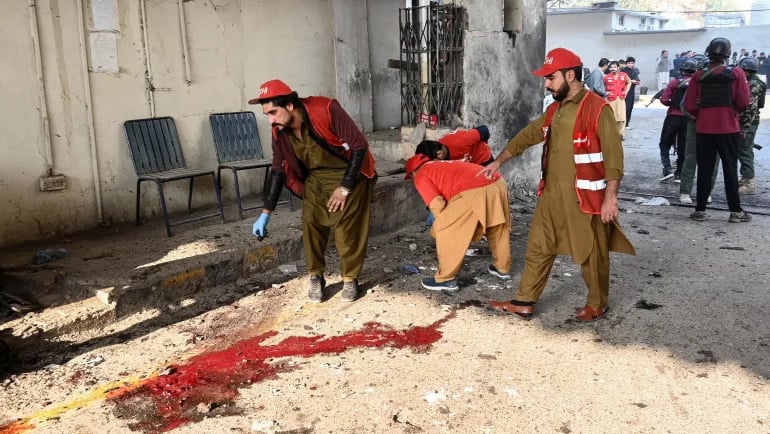
On 24 November 2025, the city of Peshawar once again witnessed a tragic and deadly act of terrorism. Three suicide attackers targeted the Federal Constabulary (FC) headquarters — one of the most sensitive security installations in Pakistan. The attack resulted in six deaths, including three FC personnel and three attackers. Several others were injured, and the brutal incident raised serious concerns about the growing security challenges in the region.
This article provides a detailed overview of how the attack unfolded, who claimed responsibility, and what it means for Pakistan’s internal security situation.
How the Attack Happened
The attack began early in the morning when the first suicide bomber approached the main gate of the FC headquarters and detonated his explosive vest.
The powerful blast killed three security officials and injured several personnel who were stationed at the gate.
Moments after the explosion, the remaining two attackers attempted to force their way into the building. They entered the premises while firing automatic weapons and throwing hand grenades in an effort to create chaos. However, security forces responded immediately. A brief but intense gunbattle took place, and both attackers were shot dead before they could reach key areas inside the complex.
Following the attack, police, rapid response units, and bomb disposal teams reached the location and sealed off the entire area. Roads leading to the headquarters were cordoned off, and a full building sweep was conducted to eliminate any additional threats.
According to security officials, the timing of the attack indicated that the terrorists aimed to target the morning parade or training drill taking place in the compound, which could have resulted in a much higher death toll.
Who Claimed Responsibility?
The attack was claimed by Jamaat-ul-Ahrar, a breakaway faction of the Tehreek-e-Taliban Pakistan (TTP).
The group has carried out several high-profile attacks in the past and is known for targeting military, paramilitary, and police installations.
Security analysts warn that the involvement of Jamaat-ul-Ahrar highlights the resurgence of militant networks in Khyber Pakhtunkhwa — a region that has faced repeated waves of terrorism over the past two decades.
Casualties and Medical Response
Killed: 3 FC personnel + 3 attackers
Injured: Multiple security personnel and civilians
Hospital Response: Injured individuals were shifted to Lady Reading Hospital, where an emergency was declared due to the high number of casualties.
Medical teams reported that several victims were in critical condition. Additional staff and ambulance services were deployed to handle the emergency situation. Building damage was also reported near the main gate and surrounding structures.
Government and Official Response
Pakistan’s Prime Minister and President condemned the attack in strong terms, calling it a “cowardly act of terrorism.” They praised the quick response of the security forces, who prevented the attackers from causing greater destruction.
Key statements included:
“The nation stands united against terrorism.”
“Security forces continue to sacrifice their lives for the safety of Pakistan.”
The Interior Ministry released a statement confirming that all law-enforcement agencies had been put on high alert following the incident.
Public Reaction
The attack sparked shock and grief throughout the country. Social media platforms were flooded with messages honoring the fallen FC personnel and demanding stronger security measures.
Many citizens also raised important questions:
How did attackers reach such a sensitive military installation?
Were there advance intelligence warnings?
What additional steps are needed to protect security complexes?
The public sentiment reflects a deep concern about the recurring pattern of militant attacks in the region.
Security Background: Rising Militancy Again
Over the past few years, Pakistan has experienced an increase in militant activity, particularly in Khyber Pakhtunkhwa and Balochistan.
Militant groups like Jamaat-ul-Ahrar and TTP appear to have reorganized their networks and are using cross-border sanctuaries to plan sophisticated operations.
Key points noted by analysts:
Sleeper cells remain active in urban areas.
Border infiltration has increased.
Propaganda and recruitment through social media continue to rise.
Peshawar, historically a major target of terrorism, has seen multiple attacks on police stations, checkpoints, and military facilities — making this latest incident part of a troubling pattern.
Expert Analysis: What This Attack Shows
Security experts highlight several alarming observations:
1. High-Level Planning
The attack showed military-style coordination:
First a gate-breaching blast, followed by an armed assault team.
This indicates advanced planning and reconnaissance.
2. Sensitive Target Choice
An FC headquarters is not an ordinary facility — targeting such a location is a direct challenge to Pakistan’s security establishment.
3. Weak Internal Security Links
Experts warn that despite years of counter-terror efforts, militant networks still possess the capability to strike high-value targets.
Future Risks and Recommended Measures
1. Strengthen Security Infrastructure
Install multi-layer physical barriers
Increase surveillance at entry points
Deploy blast-resistant gates and armored guard posts
Modernize CCTV and facial recognition systems
2. Improve Intelligence Coordination
Real-time intelligence sharing between civilian and military agencies
Use AI-based monitoring tools for detecting suspicious online activity
Strengthen border intelligence units
3. Community Awareness Programs
Encourage citizens to report unusual activity
Improve public safety education
Launch awareness campaigns against extremist recruitment
4. Youth De-Radicalization Initiatives
Counter extremist propaganda with peace-focused content
Mentorship programs in schools and universities
Rehabilitation programs for at-risk youth
5. National Counter-Terror Policy
A long-term security policy must include:
Law enforcement reforms
Economic development in vulnerable regions
Strengthened border control
Modern counter-terror training
Conclusion
The suicide attack on the Federal Constabulary headquarters in Peshawar is a stark reminder that terrorism remains a real and ongoing threat in Pakistan. While security forces displayed remarkable bravery by stopping the attackers from causing wider carnage, the incident exposes critical gaps in intelligence, surveillance, and national preparedness.
Pakistan must now take stronger steps — not only to respond to attacks but to prevent them.
By strengthening institutions, improving intelligence systems, and investing in community resilience, the nation can move closer to a future free from such tragedies.
SEO Keywords
Pakistan Peshawar suicide attack
Peshawar security complex blast
Latest news Pakistan terrorism
Suicide bombing in Pakistan
Peshawar police complex attack updates
Pakistan terrorism news 2025
KP security incident
Peshawar breaking news today
Contact
Stay updated with us
Phone
+92-300-1234567
© 2025. All rights reserved.